Hello, my name is Günter Bettinger. Nice of you interested in my fun-engines. I'm born in the first half of the last century, that is not quite that "dewy". By profession I am a mechanic and mechanical engineer. Since 1996 I have been paraplegic wheelchair since 2004, and early retirees. My hobby is designing and building small and very hot air engines. Hot air engines are machines with external combustion. It is important to me that the engines are reliable. I try the little machine a distinctive look to give them the visually different from the other known types something. But sometimes I neglect the Ideals of the thermodynamics in favor of my design ideas. Most of my mini-engine is unique. The non-ferrous metals, which I need for the production of my little machine, I'll get me most of well-stocked junk yards.
If you have fun on Motörchenbau, write me. My e-mail address: bettigue@yahoo.de


This is my "first" is. A two-cylinder reciprocating steam engine, self starting, right / left rotation. He was still being built without a milling machine, only to turn and drill and is the only one who was ready to build your plan.

The six-cylinder radial engine steam is my first self-designed model engine. He asked me and my tools from beginning to happen. In planning my goal was to build a very small steam engine. Here are some data: overall diameter 39mm, and each cylinder has two steam supply and discharge lines with a diameter of 0.45 mm; PistonØ 4mm, 6mm stroke. All 24 steam lines are located as milled grooves on a thin plate with 2mm diameter 39mm. I was pretty happy when the engine was running at first.

The Vacuum Motor (flame-eater) is a hot-air engine with open system. Already in 1758 to Henry Wood had patented the vacuum motor. The colleagues, build the fire-eaters know that these things marked "sensitive soul" are. External influences such as ambient temperature, humidity and air pressure affects the running performance. For technical reasons, has such a vacuum motor relatively little useful force. So now many must be very smooth and almost simultaneously play his work. It had several cylinder liners and pistons are tested in different material combinations. Now he has a cylinder made of glass and a carbon graphite piston. He is running optimally.

was originally built the engine in accordance with the known Bachmann engine, smaller in scale 1:2. Meanwhile, it has been modified so often that he hardly recognized and designated as "Bachmann" engine can. Dimensions: L: 120mm, W: 45mm H: 55mm. Operated it as all my hot air engines with alcohol or alcohol and a wick made of fine stainless steel mesh. Video FF-01

 My first Stirling engine. The Stirling has a closed hot air system. This is a Stirling Gama-type and similar in size to the above flame-eater. Even when I had to try out for the Stirling power piston and cylinder, different material combinations. The best ratio of displacement to volume of work, I have determined empirically for lack of experience. In this first work I have done some thermodynamic errors that have now been corrected.
 The design and construction of the four-cylinder Stirling engine, was a very challenging "work." The construction work has filled many winter days and evenings. The construction of this machine took about 8 weeks. Again, I have to the displacer tube used. This is cheap and work with a small diamond cutter well.

At the first trial run with one cylinder, I was surprised that achieves speed of this design. After the completion of all cylinders, I had to miss a simple throttle the engine brake to the speed, so he did not blow up in your ears.

This is the tank of the motor. So that the engine is as compact as possible, I have chosen for the Verdrängerschubstange a sliding drive. The work of the four piston is focused on the rocker arms in the "head" of the machine and transmitted via a plunger on the crankshaft. The displacement was divided into hot and cold region, as described by Mr. Norbert Klinner in one of his books. This measure spices up the engine performance significantly.

Here is a detailed view of the machine head.
The Stirling engine, already 150 years ago applied for a patent refers, in times of dwindling fossieler fuels, attention again. In the U.S., prominent institutions are experimenting with Stirling engines to drive generators. As one can read, with great success. One can also imagine: A thermodynamically optimal Stirling and constructed with a Parbolspiegel gebüntelte solar energy on the hot section of the machine the focused, and get a generator to operate. Similar to wind turbines of the Stirling generator then only requires little maintenance. This could have a future.
The flame eater ff-02
In the Sept. / Oct. In 2006 I built this fire-eater. He is my first completely self-constructed vacuum motor. The piston engine has a diameter of 20mm and a stroke of 28mm. On this engine I have ever tried a slightly different valve mechanism. I am familiar with most models, describes the valve disc has a circular motion. This engine has a support for the valve disc with a vertical slide guide rod that is moved by a fork on the control lever.
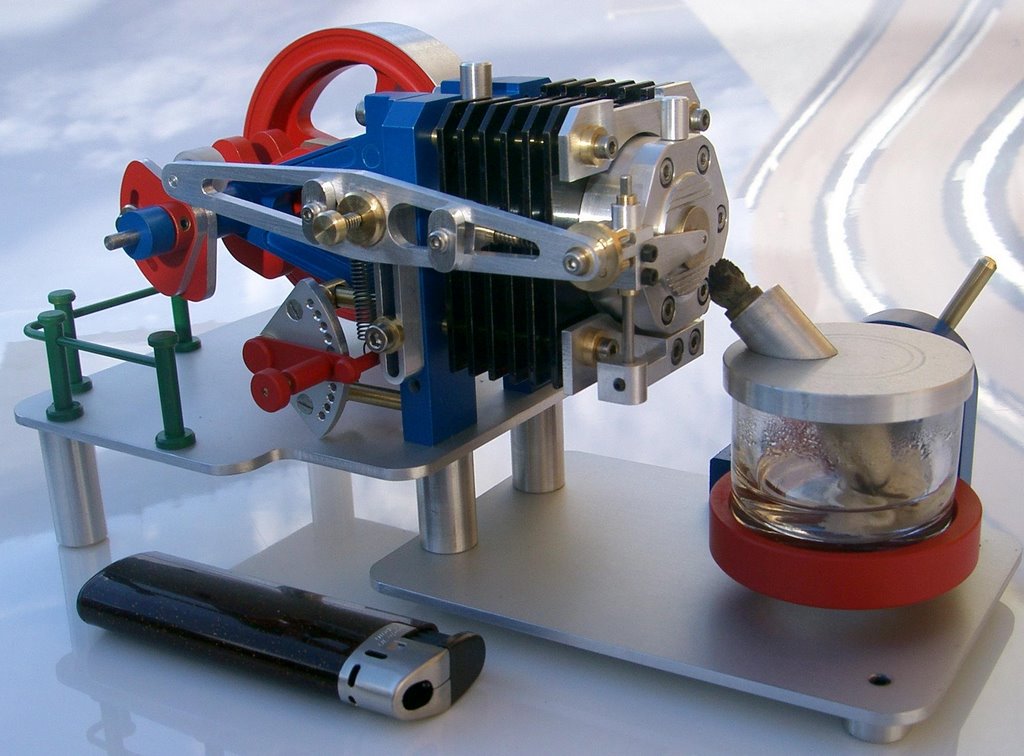
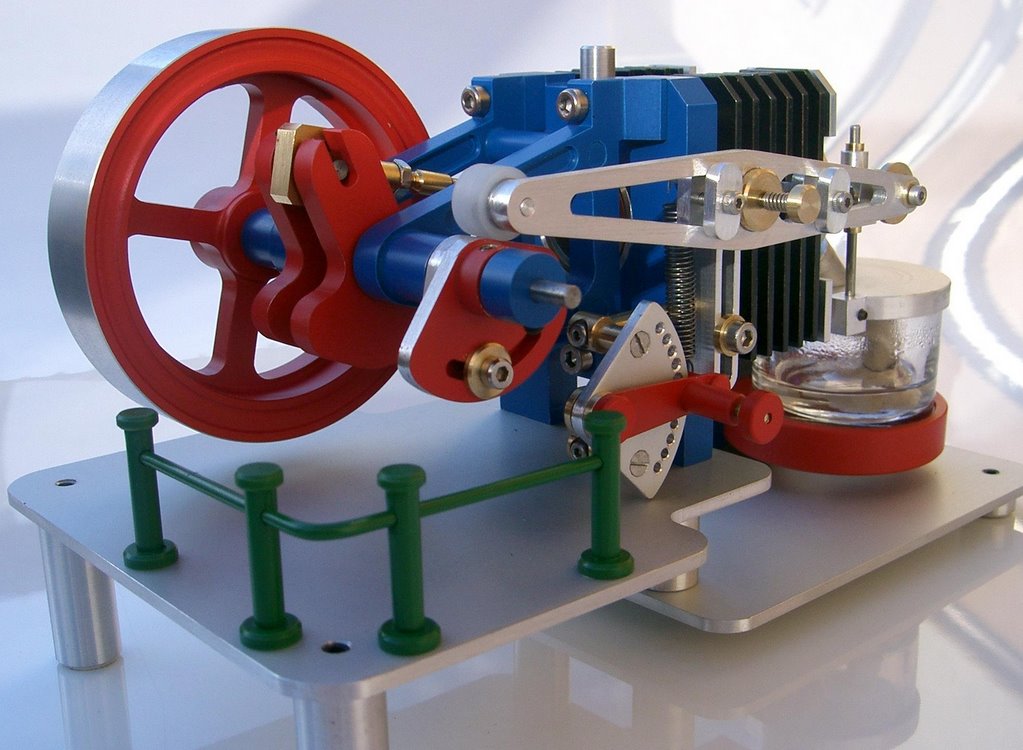 The tank is a cut glass Schaps. He stands on a platform which is adjustable in height by means of eccentrics. Thus, the flame can be in the best position to bring the fire hole. The painting was done with airbrush.
 The "tiny"
My next I would like to build models much smaller than previous ones. Such as the following. The Stirling engine "midget" has a length of 65mm (without stand). It is a beta type, ie, displacement and piston, are arranged in one axis at a time. This engine has virtually no power-eating dead volume. The pistons have a diameter of 6.4 mm. To realize the small size, I for power transmission, space-efficient, ball-bearing scenes had started. I was very surprised to reaches delusional speed of the Mini. Comment by a model colleague: "... so who goes down like Schmitz cat ..." 
video midget

video midget
Then I kostruiert an even much smaller Gama-Stirling and built. The length of the engine (without stand and burner) is 32mm. For comparison and as a visual gag in the flywheel, a 1 cent piece is incorporated. The fuel tank holds 1ml, so it runs about 12 minutes.

The "mosquito"
The next time I wanted to Stirling to my personal limits and those of my tool-equipment gone. So I designed a Stirling engine with dimensions 16x13x10mm. Without fuel the engine is as big as a 1 Euro cent. The "mosquito" is a beta-type. It consists of 37 individual parts, and "lives" in a walnut shell. The flywheel has two ball bearings. The displacement piston has a stroke of 2.6 mm and is made of titanium. The displacer is made of stainless steel. He is using Teflon sleeve, against the heat sink is thermally insulated. The piston is made of bronze, with 1.5 mm stroke, in a steel cylinder with a diameter of 3 mm. The tank nearly 0.5 ml of methylated spirits, so the engine runs 10-12 minutes. With tank and torch weighs the "mosquito" about 4 grams Model colleagues who know the international "scene", are of the opinion that the "mosquito" is one of the smallest known Stirling engines.
The next time I wanted to Stirling to my personal limits and those of my tool-equipment gone. So I designed a Stirling engine with dimensions 16x13x10mm. Without fuel the engine is as big as a 1 Euro cent. The "mosquito" is a beta-type. It consists of 37 individual parts, and "lives" in a walnut shell. The flywheel has two ball bearings. The displacement piston has a stroke of 2.6 mm and is made of titanium. The displacer is made of stainless steel. He is using Teflon sleeve, against the heat sink is thermally insulated. The piston is made of bronze, with 1.5 mm stroke, in a steel cylinder with a diameter of 3 mm. The tank nearly 0.5 ml of methylated spirits, so the engine runs 10-12 minutes. With tank and torch weighs the "mosquito" about 4 grams Model colleagues who know the international "scene", are of the opinion that the "mosquito" is one of the smallest known Stirling engines.


The "Mosquito" is very reliable. She has since been completed in some exhibitions so many hours of operation successfully.
The flame eater ff-03 is a small, vertical engine. This model, like most of my models, unique. For the construction of fire-eater, I wanted to test whether the sensitive vacuum motors also run small volume still good. Fortunately, this is very good here. He has a piston diameter of 8mm, 18mm and a stroke. The piston I have made of carbon graphite. The engine weighs 290 grams and has a tank volume of 1.5 ml He workflows about 12 minutes. Eddy current brake is the min speed of 1000-2000 rpm can be varied. Most parts are made of brass and gold-plated.

The "flea"
In the first half of 2008 I ventured on the seemingly impossible. It should be a tiny Stirling engine, the length, width and height are each less than 10mm. After completion of the construction work, were the external dimensions of the engine (without stand) that: length 9.5 mm, width 7.9 mm and height 7.8 mm. The motor (without base) consists of 36 items. The piston has a diameter of 1.8 mm and a stroke of 1-1.2 mm. It is made of bronze and running within a cylinder of steel. The displacer is made of carbon graphite, has a diameter of 2.3 mm and a stroke of 1.8 mm. The Verängerzylinder is made of stainless steel. The diameter of the flywheel bertägt 7.4 mm. The engine weighs less than 1g. The base placed in the tank holds 0.5 ml To prevent misunderstandings: The match is not in the picture Fire Lighter, but a commercially available, small match.

actually reach the surface qualities of the I can reach with my tools, not for such a micro. Every time I had made some and thought it would be viewed with appropriate magnification, the disillusionment came regularly regarding the progress surface qualities. I had to learn that I did not always have the necessary peace of mind to be able to produce such small items with lots of patience. At the slightest hint of stress I had to immediately stop the work, otherwise I risked to produce only waste. Again and again I've flicked finished parts with tweezers away, or they fell off. The search for the particles was usually unsuccessful. Since it was my teeth and bite again customize. After plenty of changes to the design and the remakes, the time came for the first test run. And indeed, the little thing ran. But as expected, leads the slightest disturbance, such as the smallest dirt particles to an immediate standstill. Unfortunately, it is somewhat difficult to get the engine running. The core problem is this: At such a small little machine you always have a large flame, which quickly heats the entire engine. This burn lubricants, which in turn glued to the camps. You have to disassemble the engine before each run and thoroughly cleaned. This is of course extremely annoying. I have decided to build again such a small Stirling, running without lubrication.
I think with the flea my series of reductions is completed for now. If you wanted to build more small, one would have to leave the amateur character and customize the parts on porfesionellen machines. The "flea" I have reached my personal "end of the story."

vs fly. Flea

flea with stand and burner

The next engine is for a change slightly larger. Around November 2008, the construction work of the FF-04-V2 closed and it went to the construction of the fire-eater. The engine is hung in a frame of mahogany wood. For valve control, I used a desmodromic control. This is a positive guide to a return spring spared. So that the engine in the hot region does not need any lubricants, the cylinder liners are made of glass again and the piston of carbon graphite. The concerns that the thin-walled (0.8 mm) to break glass cylinder fortunately not confirmed. As a special gag, the aluminum heat sinks are slit longitudinally so that the piston movement can be seen in the cylinder. In the darkened room, the flame has been sucked to see through the glass cylinder. The glass parts of the two tanks are manufactured as the cylinder tube. The mahogany base is treated with a Ballenmattierung.

video "FF-04-V2"
In June 2009 I have constructed a thermo-acoustic engine. This is probably the simplest heat engine, but perhaps the most interesting physically.

It consists of only a few functional parts: a test tube of inner diameter 6.6 mm, a plug of fine steel wool, a pinhole and a working piston and connecting rod made of graphite with a flywheel. heated at the right place, the machine runs very reliably with about 1200 rpm. It is completely maintenance-and wear-free.
2010 followed a similar thermal acoustic engine with piston diameter 8.8 mm. has

Next It irritated me to build a possible small-volume vacuum motor. The smallest fire-eater that I am aware, have a piston diameter of 8mm. So it should be a little machine with only 5 mm piston diameter and stroke to diameter ratio of 1.9:1, because a small volume soooo fire-eaters have not yet found on the web. Because I've had a glass cylinder with carbon graphite piston only good experiences, I have again opted for this solution.


fire eaters to build small, a little more difficult than reductions of Stirling engines, for the Stirling works with every stroke in both directions, only one of the FF. Originally it was to be a stationary engine with bottom inlet. But was not feasible, because the time blazing lights, let the machine to overheat quickly. So I tilted the engine by 60 °. He runs very well and reliably. Now, the obvious question: "Does it even smaller ... Let's gaze..


fire eaters to build small, a little more difficult than reductions of Stirling engines, for the Stirling works with every stroke in both directions, only one of the FF. Originally it was to be a stationary engine with bottom inlet. But was not feasible, because the time blazing lights, let the machine to overheat quickly. So I tilted the engine by 60 °. He runs very well and reliably. Now, the obvious question: "Does it even smaller ... Let's gaze..
that the engine flywheel by an overhead is not too top heavy, I have it installed on gears with module 0.5 down. At the "small" a total of 11 pieces particularly smooth running ball bearings are installed.
A stylish gear for Sirlingmotoren is the "Ross-Yoke", named after its inventor, Andy Ross. The Ross transmission is well suited for compact designs. Because I like to build small and compact, should my next Stirling be equipped with a Ross transmission. The first requirements for the engine were as follows: Gama-type, piston distance 8mm, 3mm stroke, hidden, flywheel. In June 2010, I started construction of the "crumbs". The design and construction took approximately 150 hours. At first he did not run so well. Only when I had the brass flywheel exchanged against one of lead eliminated the problems. After completion of the final I was pleasantly surprised by the performance of the little ones. At the lowest possible flame, it runs about 500 rpm, with a 3mm flame, about 3000 rpm.


